Dome Master 2026 roadmap.
DOME MASTER | 2025 recap and proposed next steps for 2026
Dear all,
As we approach the end of 2025, we would like to briefly reflect on the DOME MASTER initiative we
started together this year, thank everyone for their contributions, and outline a proposed path
forward into 2026.
The original intent of initiating the DOME MASTER roundtable was to explore whether the Flying Ride
/ Flying Theatre industry could benefit from a shared, future-oriented approach to producing a
“dome master”, one that simplifies content exchange across venues while respecting different
technologies, business models, and creative freedom.
Based on the quality of discussion and the level of engagement so far, it is clear that this exploration
is both relevant and timely.
1. What we achieved in 2025
Initial DOME MASTER Roundtable
In 2025 we held an initial DOME MASTER roundtable session to:
• test whether there was sufficient shared interest and alignment,
• identify real-world challenges in distributing and adapting dome-based content,
• and explore whether a common DOME MASTER or Dome Archival Master methodology
could be meaningful for the industry.
The session notes and recording were shared with the group as a reference point.
Substantive contributions received
Following the roundtable, several participants provided in-depth written input. We would like to
explicitly thank the authors of the following foundational documents:
• Scott Gatteño – FTA Flying Theater Audio Standards (Notes)
A comprehensive exploration of venue audio requirements, calibration, testing, and forward-
looking approaches to immersive and object-based workflows.
• Phillip Hartl / Kraftwerk Living Technologies – FT Audio Notes
A practical, experience-driven response that complements the above, highlighting
integration realities, stability considerations, and delivery approaches for live venues.
• Thomas Gellermann / Kraftwerk Living Technologies – VTC Flying Theater DOME MASTER
(notes and subsequent comments)
*** MARC: Please reference and summarize Thomas’ document “VTC Flying Ride DOME
MASTER specifications” and subsequent responding comments to questions in my email,
dated 10 November 2025
• John Daro – FTA-WG-RP 001: Recommended Practice for Scene-Referred Mastering
A clear and well-structured proposal for the visual mastering pipeline, centered on ACES 2.0
and a single DOME MASTER / Dome Archival Master (DAM) as the source of truth, from
which all venue-specific deliverables are derived.
Together, these contributions demonstrate that the group already shares a strong technical
foundation, even where open questions remain.
2. Why a next step is appropriate & why audio and visual should be separated
One important insight from the 2025 discussions is that, while closely related, audio and visual
mastering require different types of focus, expertise, and decision-making.
To move from exploration to convergence without overloading plenary discussions, we propose to
continue the DOME MASTER initiative through two focused breakout tracks:
• Track A – DOME MASTER (Audio)
Venue standards, calibration, object-based versus channel-based delivery, intermediary
formats, robustness, and scalability.
• Track B – DOME MASTER (Visual / Video)
Dome Archival Master workflows, ACES-based mastering, LED versus projection targets,
frame rate, geometry / field of view, and chroma / bit-depth considerations.
3. Proposed structure for early 2026
The intention is to keep the initiative lightweight, collaborative, and outcome-driven, while ensuring
that participation remains valuable and enjoyable for everyone involved.
Step 1 – Two DOME MASTER breakout sessions
Each breakout session would aim to:
• distill the 2025 input into:
o a minimum baseline set of specifications,
o a recommended / future-proof practice,
o and a clear list of any open questions for further resolution.
• agree on what is in scope for an initial DOME MASTER specifications – Recommended
Practice v0.1, and what should be deferred.
Each session would result in a concise written output (approximately 1–2 pages). Rick Rothschild has
kindly indicated his willingness to chair and guide these breakout sessions.
Step 2 – DOME MASTER Roundtable #2 (plenary)
The group would then reconvene to:
• share the outcomes of both tracks,
• align on a combined perspective,
• and whether this represents a solid and useful first version of a DOME MASTER specifications reference framework.
Step 3 – Proposal for continuation
Following this alignment, we would present a proposal for how the DOME MASTER initiative could
continue beyond this phase, potentially including:
• a very light, neutral platform or “FTA-lite” structure,
• clear recognition of contributors,
• a non-vendor-driven positioning,
• limited but meaningful deliverables over time,
• and a model that supports collaboration without creating competitive or political friction.
4. Indicative timeline
To maintain momentum while respecting everyone’s availability, the following timeline is proposed:
• Week 3 of January 2026 – DOME MASTER (Audio) breakout
• Week 4 of January 2026 – DOME MASTER (Visual / Video) breakout
• Mid-February 2026 – DOME MASTER Roundtable #2 (full group)
Detailed agendas and pre-read materials will be shared in advance.
5. Closing
The DOME MASTER discussions in 2025 have shown that this group has the experience, trust, and
shared motivation to meaningfully improve how dome-based content is created, mastered, and
distributed.
The ambition for 2026 is not to over-standardize, but to create clarity where clarity helps, and to do
so in a way that remains open, collaborative, and sustainable.
Thank you again to everyone who contributed time and insight this year. We look forward to
continuing this conversation as we move forward.
Marc Koerts
Rick Rotschild
December 2025
Dome Master Working Group Kick off meeting 10/29/2025
Flying Theater Association
Working Group on Visual Media Standards
Document: FTA-WG-RP 001
Title: Recommended Practice for Scene-Referred Mastering
1. Objective
To establish a standardized, future-proof mastering workflow for flying theater content. This practice defines a single, scene-referred Dome Archival Master (DAM), created using the ACES 2.0 framework, from which all venue-specific deliverables are derived.
2. Core Framework
Color System: ACES 2.0. This open-source, scene-referred framework is mandatory for managing color from grade to final delivery.
Archival Master (DAM) Specification:
Format: OpenEXR (16-bit half-float)
Color Space: ACES 2065-1 (AP0 primaries, scene-referred linear)
Description: This is the definitive, graded, source-of-truth file containing the full scene-referred dynamic range.
3. Standardized Mastering Workflow
Primary Grade: Perform the creative grade in a standard digital cinema environment (48-nit, P3-D65, gamma 2.6).
Archive: The final approved grade is saved as the Dome Archival Master (DAM) in ACES 2065-1 format.
Derive Deliverables: Generate each required master by applying the appropriate, standardized ACES Output Device Transform (ODT) to the DAM.
4. Key Deliverable Targets - Deliverable / Display Target / Peak Luminance / Gamut
EOTF ODT LED Dome (Primary) = High-Luminance LED1000 nits P3-D65 / ST 2084 (PQ)ACES 2.0 ODT (Custom)
Projection (Legacy) = Projection Dome10 nits P3-D65 gamma 2.6 ACES 2.0 ODT (Custom)
DI Reference = Digital Cinema48 nits P3-D65 gamma 2.6 ACES 2.0 ODT (Standard)
SDR Review = SDR Monitor100 nits Rec. 709 BT.1886ACES 2.0 ODT (Standard)
*Note on LED Dome Target: The PQ-based master is delivered in a 1000-nit container, but the creative grade should be performed with a 300-nit practical peak in mind to respect hardware longevity and the perceptual brightness of a 180-degree dome environment.
5. Notes on Transforms and Flexibility
Gamut Flexibility: The DAM (in ACES 2065-1) contains all color information. While the primary targets are P3 and Rec. 709, this workflow allows for the easy generation of wider-gamut deliverables (e.g., Rec. 2020) for any venue with capable display hardware.
ODT Authoring: The custom ODTs required for this workflow (e.g., 10-nit P3 gamma 2.6 and the PQ-based LED Dome ODTs) will be professionally authored in collaboration with the Academy, John Daro, and Filmlight to ensure technical accuracy and industry-wide consistency.
6. Mandatory On-Site Calibration (Venue LMT)
The standardized deliverables are considered starting points, not final exhibits. Each venue must perform on-site calibration.
This process involves creating a venue-specific Look Modification Transform (LMT) to be applied before the ODT. This LMT corrects for hardware variance (LEDs, projector age) and environmental factors. For example, a 10-nit projection dome LMT would likely require a significant boost in saturation and contrast to compensate for black-level lift caused by environmental cross-reflection.
7. Format and Resolution
Using Dome Master format with 180° HFOV, the minimal vertical FOV should be 140° (50° above the equator. An Ideal resolution for 20/20 vision would be 10800 horizontal pixels on 180°. Leading into 8446 pixels vertically. (TBD)
(to be noted, some Flying Theater are built with full dome vertically at 180° as well)
The DomeMaster shall be defined in classical form with even pixel distribution. Flat camera mapping with fisheye lenses should be seen as an option for conversion for specific environmental conditions.
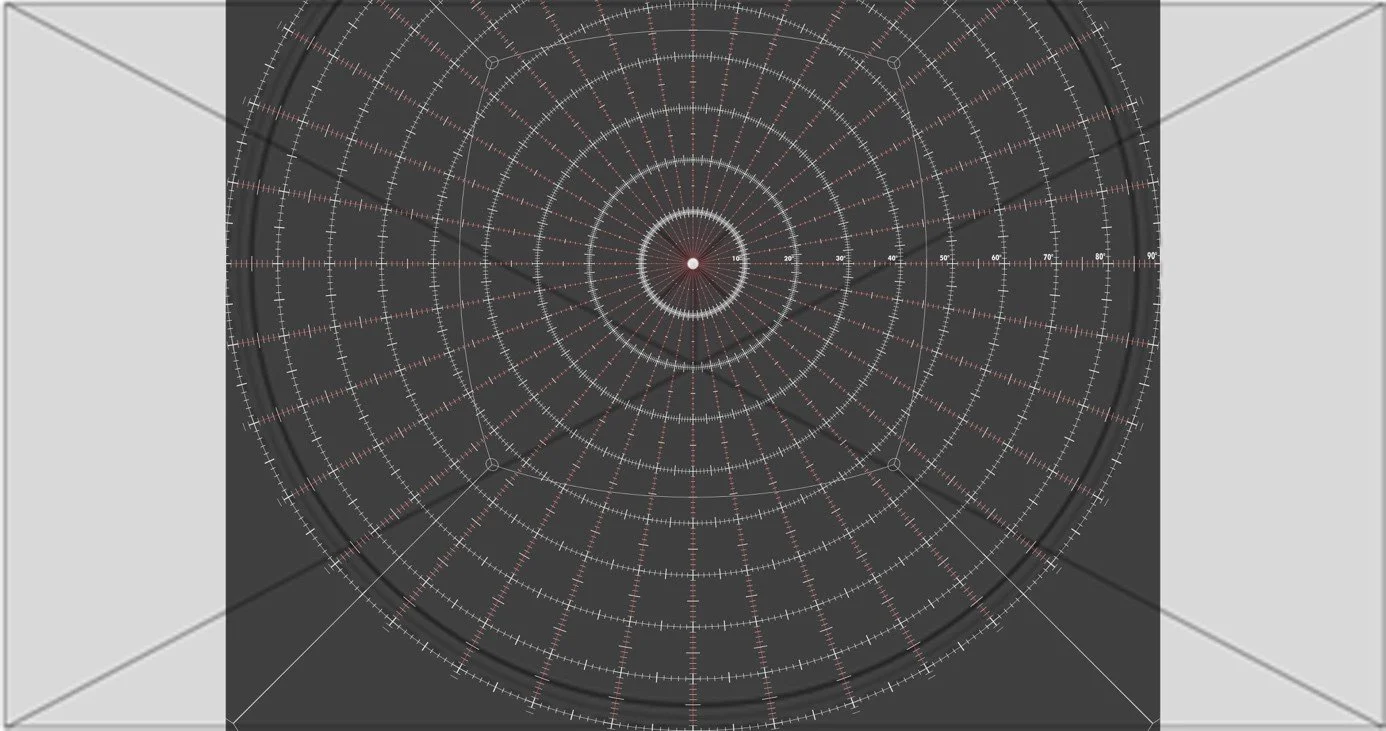
DomeMaster
» 120Hz frame rate
» 10-bit 4:4:4 RGB
» Colour Space: Rec. 709 / Rec. 2020
» Gamma: 2.4
» Whitepoint: D65
The screen system is a spherical dome-shaped screen and shall provide a minimum of 16% acoustic transmission.
Projection screens shall be coated with an ultra matt surface optimized at a constant screen gain of ~0,4.
The playout system shall support full frame uncompressed playback at 120Hz, 10-bit 444 RGB for uncompromising source quality.
Uncompressed data transmission allows for a full 120Hz, 10-bit 444 RGB signal pipeline for zero signal loss and 1:1 signal transmission from source to display