• credits
  • blog
  • projects
  • about
  • contact
Menu

John Daro

  • credits
  • blog
  • projects
  • about
  • contact
×

Color Grading & Finishing

The Metamerism Monster: Why Your Displays Don’t Match - And Why It’s Your Eyeballs' Fault

JOHN DARO October 9, 2026

Nothing ruins a client session faster than two perfectly calibrated displays looking like they were finished in two completely different color spaces. You check the numbers… spot on. You check the probes… locked dead at D65. Both hit x=0.3127, y=0.3290 perfectly. Yet the QD-OLED client monitor and the laser projector refuse to speak the same visual language. Then the director looks up, points at the projection, and asks why everything looks green. If you’ve ever had to explain metameric failure to a room full of tired filmmakers you know exactly what I’m talking about. So what gives?

A brilliant new white paper, Why the colours of modern displays can look so different to different observers (Rider, Frith, and Stockman, 2026) published in Optics Express, dives deep into exactly this. I highly recommend reading the article in full to see the underlying math. But for now, let's break down this incredibly well researched and dense science into what it actually means for us colorists.
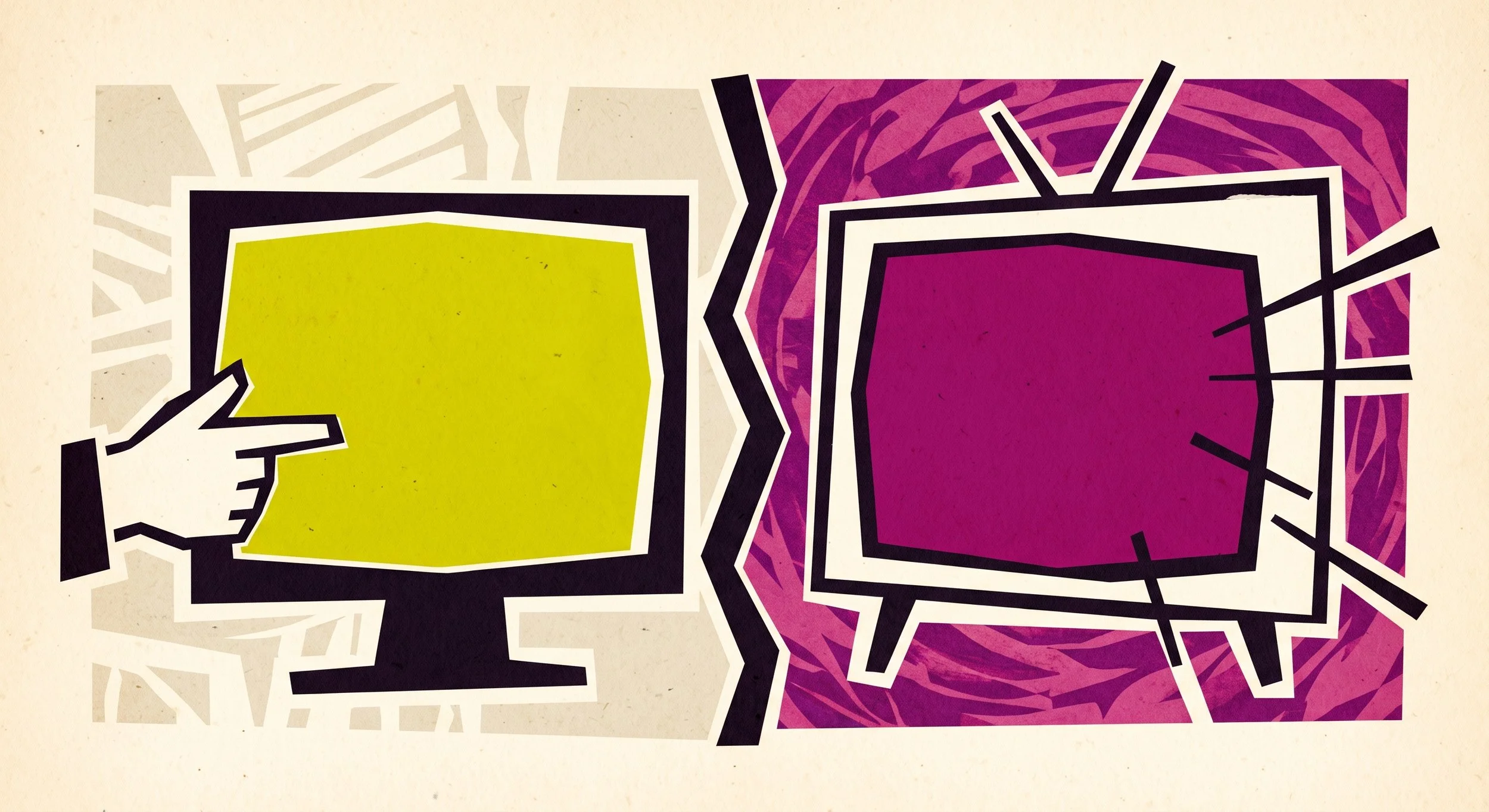
I know I sound like a broken record, but I have always said that you should never have your HDR up vs your theatrical comparing the two (although I have many times in the past at filmmaker request with much protest from my side.) They are apples to oranges and will make your trim off unless you take each one individually. When you put two completely different display technologies side-by-side, you're not just fighting the displays, you're fighting human biology.

Here is why.

The Paint Roller vs. The Sharpie, Broadband vs. Narrowband

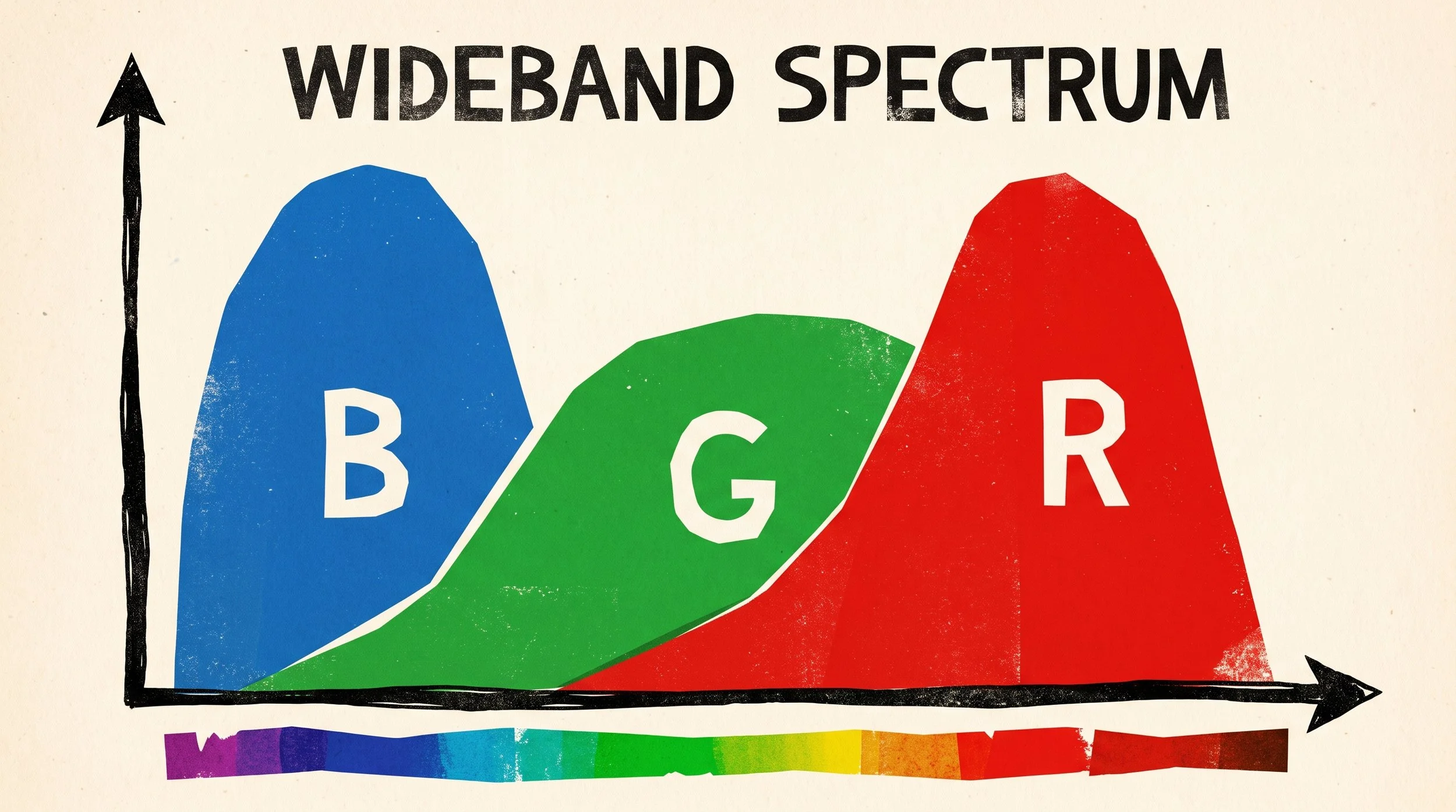
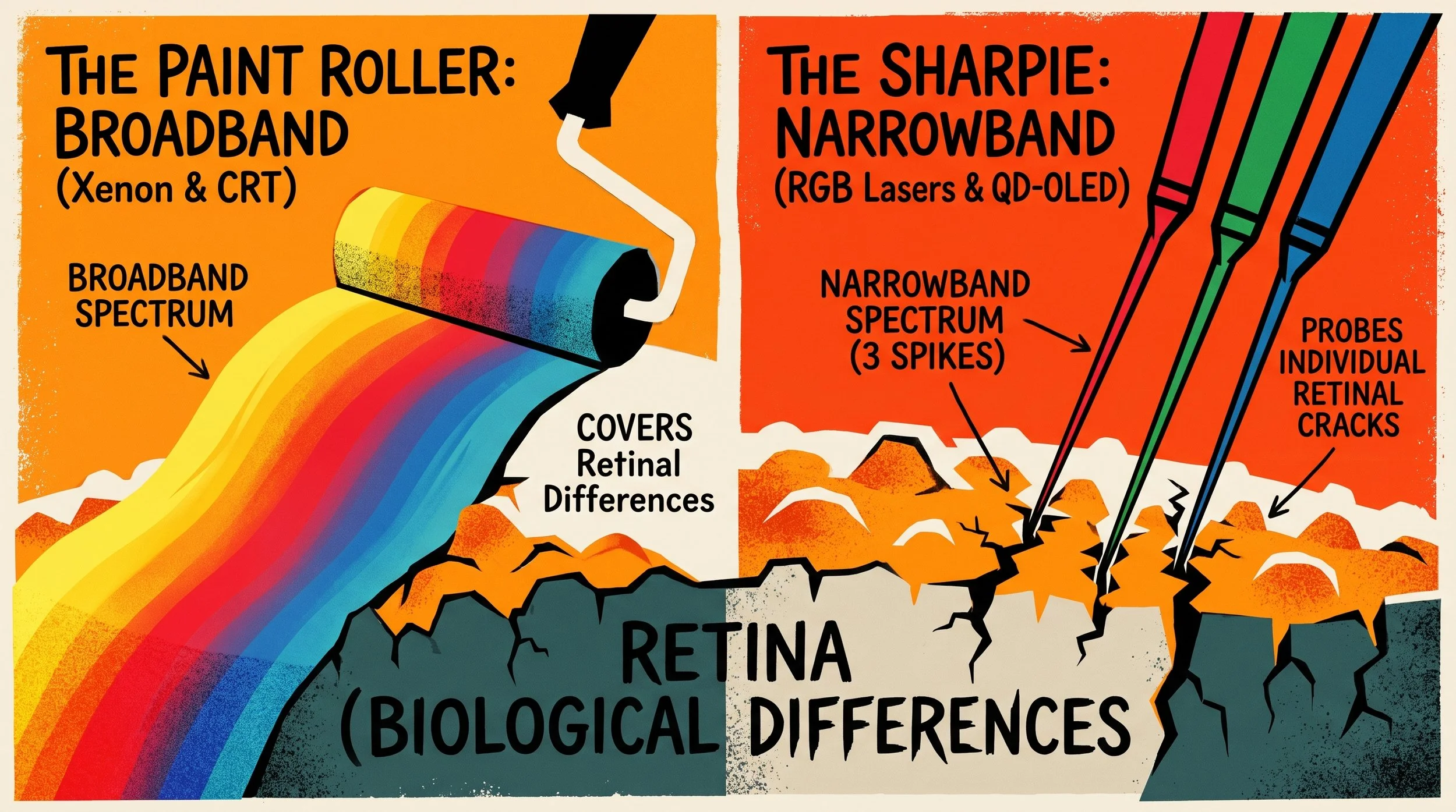
Historically, we mastered on cathode ray tubes (CRTs) and Xenon arc-lamp projectors. These older technologies used what we call "broadband" primaries. Think of broadband light like painting a wall with a thick, fluffy paint roller. If there are small cracks or biological differences in the "wall" of our retinas, the thick roller covers them up smoothly. Because CRTs and Xenons painted with wide, continuous swaths of the spectrum, they effectively paved over the slight biological differences between my eyes, your eyes, and the director's eyes.
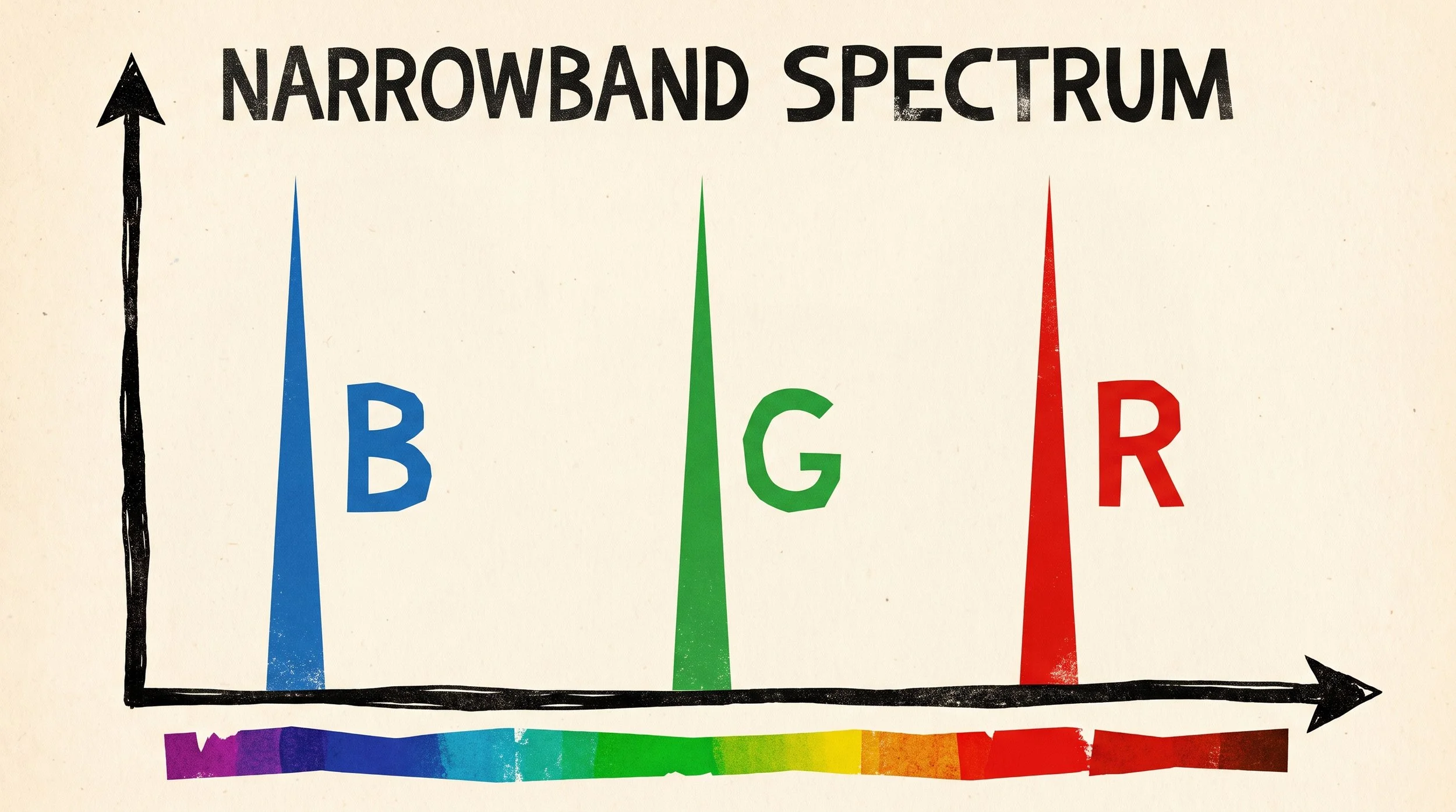
Enter modern displays: RGB lasers and Quantum Dot OLEDs. These use "narrowband" primaries, which are basically sharp, needle-like spikes of pure color. Think of this like drawing on that same wall with a fine-tip Sharpie. Suddenly, every tiny crack and bump matters. When you use pure monochromatic laser primaries, they act like a precision probe directly testing your unique retinal biology.
The Genetics of Color, Why Women Are Just Better

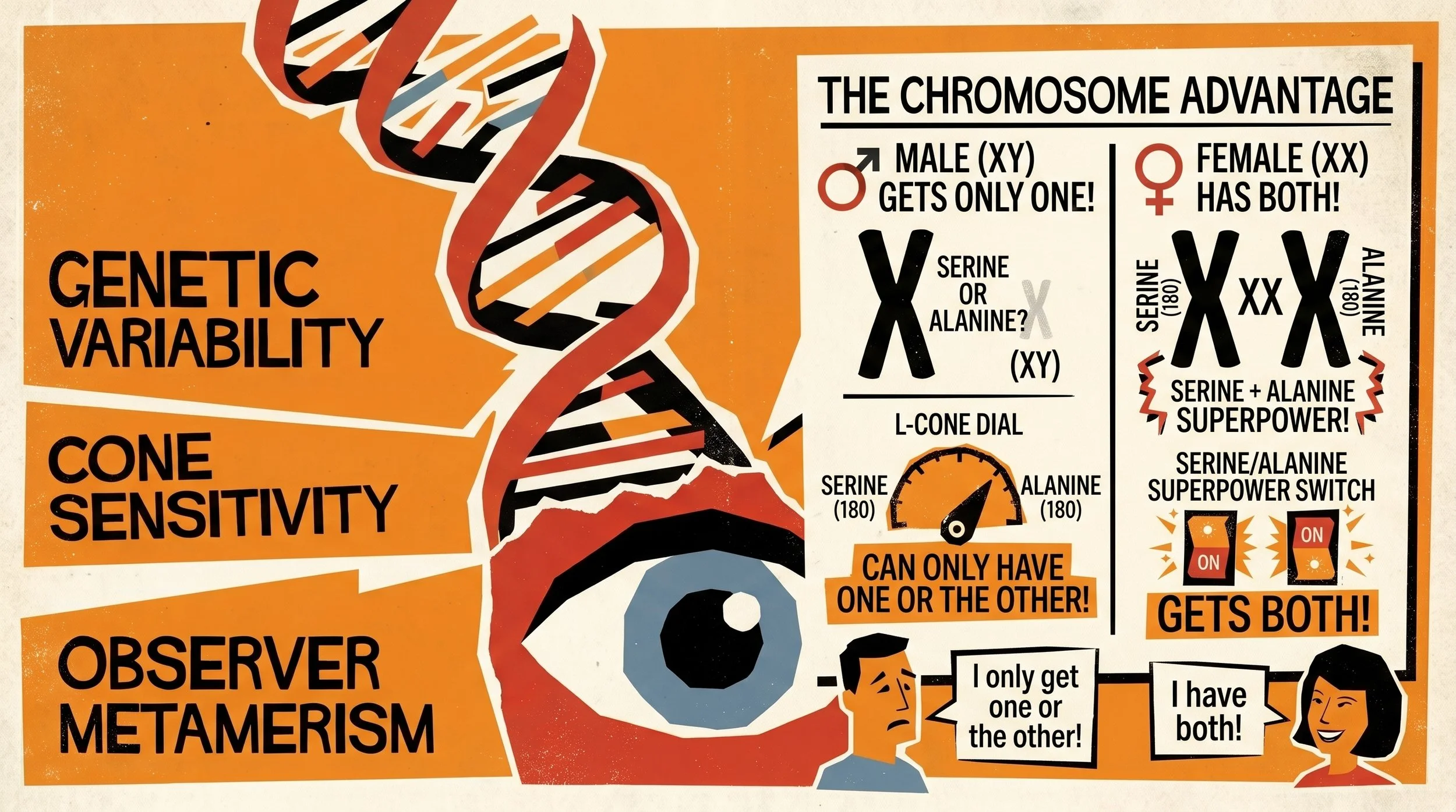
Here is where the biology gets wild. Normal human color vision relies on cones in our retinas (Long/Red, Middle/Green, Short/Blue). But there is a common genetic variant that changes the exact peak sensitivity of your Red (L) cone. It comes down to whether your DNA codes for the amino acid Serine or Alanine at position 180 of the opsin gene. This single structural change shifts your L-cone peak by about 4 nanometers.

I have always said women make the best colorists, and biology offers an intriguing case for why. Because the genes coding for red and green photopigments reside on the X chromosome, women have two shots at the genetic lottery where men only get one. At position 180 of the red cone opsin gene, a common variation codes for either the amino acid serine or alanine, subtly shifting that cone's peak spectral sensitivity. A woman can inherit one version on each X chromosome, expressing four distinct retinal cone classes instead of the standard three.

​About 12% of women carry the retinal hardware for this potential tetrachromacy, a term I first heard from my bud and fellow colorist Ian Vertovec about 15 years ago. While possessing that fourth cone doesn't guarantee the brain develops the neural pathway to use it, theoretical models suggest a functional tetrachromat could perceive tens of millions more color gradations than the average eye.

​Too bad for the dudes. With only one X chromosome, we are locked into whichever single variant we inherit, leaving us far more vulnerable to color vision deficiencies. Even between two males with certified "normal" vision, that simple 4 nm shift between the serine and alanine variants is noticeable. In a narrowband RGB laser projector setup, that genetic split alone can result in up to a 12% disagreement on the red-to-green ratio required to perceive a patch as pure neutral white.
My Old Aging Eyes

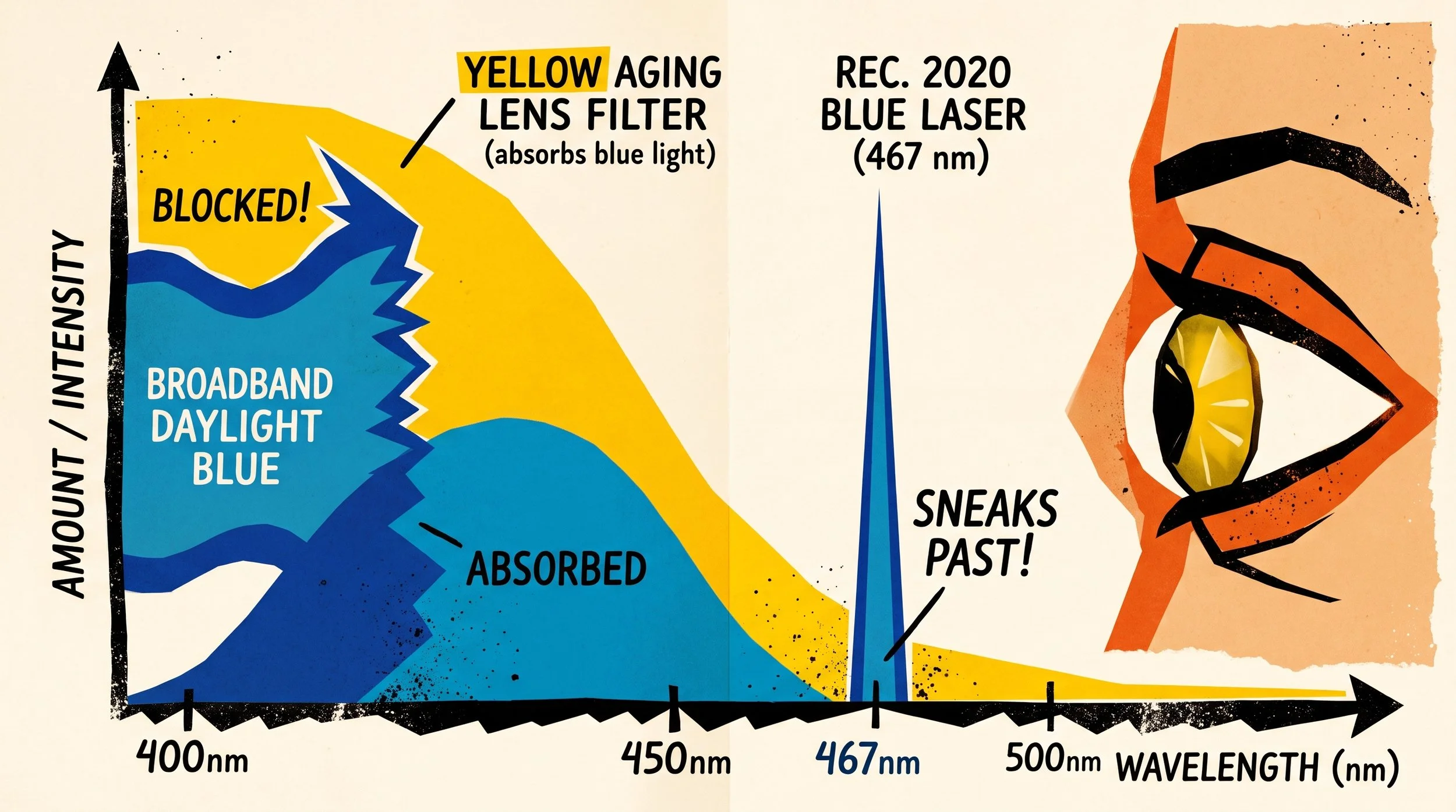
As we age, the crystalline lens in our eye gets denser and turns slightly yellow, acting like a built-in warming filter that absorbs short-wavelength (blue) light. You’d assume this means older observers would see all modern displays as too warm. But narrowband displays pull a fast one.

Because standard gamuts like Rec. 2020 use a very specific blue primary anchored at 467 nm, that blue laser spike sneaks right under the heaviest part of the eye's yellow aging filter. So, when viewing a display calibrated to daylight (which has broad blue light that does get blocked by the aging lens), an older observer will actually see the narrowband screen as having a magenta’ish or blue-red wash. A younger colorist with crystal-clear lenses will look at the exact same screen and see a greenish-yellow wash. This explains why I’m always fighting with my older Projection Engineering team 🤣
Actionable Best Practices for the DI Theater

So, how do we grade in a world where everyone's eyes are biologically different?

  1. Don't Fight the Probes, But Know Their Limits: The standard we use to calibrate monitors (CIE 1931) is fundamentally flawed because it mathematically underestimates blue light. This is why identical x,y coordinates look totally different on a CRT versus an OLED. It might be time to rethink my stance on Judd offsets, but that’s a different post.

  2. Isolate Your Environments: Stop putting laser projectors and OLEDs in the exact same sightline. When you flick your eyes between them, your visual system cannot chromatically adapt properly. The macula in your eye (which physically absorbs blue light) creates a phenomenon in your central vision called Maxwell's spot. Usually, your brain filters this out, but when you rapidly switch your gaze between two spectrally different displays, the spot becomes transient. This retinal lag makes side-by-side matching of different display tech a physiological nightmare, even for a single observer no matter how experienced.

  3. Acknowledge Biological Reality: When the DP says the laser looks green and you think it looks magenta, neither of you is crazy. It’s observer metamerism failure. You have to find a creative consensus, knowing that pure calibration won't fix genetics.

Next time you are arguing over 1 point of green in the shadows on a laser projector, just remember, it might just be your amino acids talking.

Read the original article here: https://doi.org/10.1364/OE.613255

Happy Grading,

JD

In Color Grading Tags ObserverMetamerism, MetamericFailure, ColorScience, Colorimetry, ConeFundamentals, CIE1931, CIE2006, CIE2015, VisualPerception, ChromaticAdaptation, MacularPigment, ColorMatching, QDOLED, OLED, RGBLaser, LaserProjection, NarrowbandDisplays, BroadbandDisplays, HDR, Rec2020, WideColorGamut, WCG, DisplayTech, XenonProjector, ColorGrading, Colorist, ColoristSociety, PostProduction, DigitalIntermediate, DI, FinishingBay, HDRGrading, ColorCorrection, FilmMaking, DisplayCalibration, ColorManagement, WhitePoint, JuddVos, PerceptualMatch, MonitorCalibration, ColorAccuracy, PostWorkflow, Spectroradiometer, Observer metamerism in displays, HDR display calibration, Metameric failure color grading, QD-OLED vs Laser Projection, CIE 1931 short-wavelength error, Perceptual white point matching, Judd-Vos offset calibration, Rec 2020 laser primary metamerism, Retinal biology color perception, Visual white point offset DI suite, John Daro, Ian Vertovec, Water Tower Color
Comment

Search Posts

No results found
  • October 2026
    • Oct 9, 2026 The Metamerism Monster: Why Your Displays Don’t Match - And Why It’s Your Eyeballs' Fault Oct 9, 2026
  • July 2026
    • Jul 30, 2026 Filmlight + John Daro in Japan Jul 30, 2026
    • Jul 23, 2026 ALE to CCC Converter: A Quick Workflow Utility Jul 23, 2026
  • June 2026
    • Jun 16, 2026 Into the Depths: Resurrecting Golden Age 3D at Water Tower Color Jun 16, 2026
  • May 2026
    • May 19, 2026 Go Speed Go: Remastering the Hyper Color World of Speed Racer in 4000-Nit HDR May 19, 2026
    • May 14, 2026 What Is Too Bright? Navigating Creative Intent in the HDR Era May 14, 2026
  • March 2026
    • Mar 24, 2026 Spinning in Style: Coloring a 360° RED Camera Rig for Balenciaga Mar 24, 2026
  • February 2026
    • Feb 17, 2026 If you are in Tokyo 6/23 Feb 17, 2026
    • Feb 4, 2026 Bit Depth Deep Dive: The Mathematics of the Digital Canvas Feb 4, 2026
  • November 2025
    • Nov 5, 2025 Netflix's "In Your Dreams" Premiere Nov 5, 2025
    • Nov 5, 2025 Somewhere Over the... Sphere? Grading The Wizard of Oz for a New Dimension Nov 5, 2025
    • Nov 5, 2025 A Big Day for "The Work We Do in the Dark": IMDb Launches the "Color Department" Nov 5, 2025
  • October 2025
    • Oct 16, 2025 Thanks for joining the "Ask the Colorist" panel at SMPTE 2025! Oct 16, 2025
    • Oct 7, 2025 Join Me for the 'Ask the Colorist' Panel at the 2025 SMPTE Summit! Oct 7, 2025
  • September 2025
    • Sep 26, 2025 In Your Dreams | Official Trailer | Netflix Sep 26, 2025
  • August 2025
    • Aug 29, 2025 The Wizard of Oz at Sphere Aug 29, 2025
    • Aug 29, 2025 Niagara Takes Flight Aug 29, 2025
  • July 2025
    • Jul 2, 2025 LG Roadshow - A New Era of Home Entertainment: Ambient Light Compensation Jul 2, 2025
  • June 2025
    • Jun 2, 2025 ACES at Cine Gear Saturday June 7th Jun 2, 2025
  • May 2025
    • May 8, 2025 WB Tour Spot May 8, 2025
  • April 2025
    • Apr 24, 2025 Until Dawn out today Apr 24, 2025
    • Apr 14, 2025 Bridging Eras: How AI is Reimagining 'The Wizard of Oz' for the Sphere Apr 14, 2025
  • February 2025
    • Feb 12, 2025 Building a Retro CRT Effect: From Shadertoy to Baselight Matchbox Shader Feb 12, 2025
  • December 2024
    • Dec 22, 2024 Color Timer Podcast Dec 22, 2024
  • November 2024
    • Nov 23, 2024 Introducing Water Tower Color Nov 23, 2024
    • Nov 21, 2024 Water Tower Color is Open Nov 21, 2024
  • October 2024
    • Oct 11, 2024 Section Meeting Tuesday, October 15 6 - 8:30 pm Oct 11, 2024
  • September 2024
    • Sep 19, 2024 Best Practices - Remote Color Approvals on iPad Pro Sep 19, 2024
  • August 2024
    • Aug 1, 2024 HDR by Barco Aug 1, 2024
  • July 2024
    • Jul 26, 2024 How to - Add a LUT in Avid Media Composer Jul 26, 2024
  • May 2024
    • May 29, 2024 John Daro's Take on the Future of Color Grading: AI, Cloud, and Remote Workflows May 29, 2024
  • April 2024
    • Apr 11, 2024 Baselight X Grade: A Game-Changer? Hands-On Impressions Apr 11, 2024
    • Apr 11, 2024 ShotDeck & the Art of the Steal: How References Fuel Your Vision Apr 11, 2024
  • March 2024
    • Mar 21, 2024 The Kardashians Season 5 Teaser Mar 21, 2024
    • Mar 20, 2024 8AE - Really Really Mar 20, 2024
  • January 2024
    • Jan 1, 2024 HDR - Flavors and Best Practices Jan 1, 2024
  • November 2023
    • Nov 28, 2023 Big Congratulations to tonight's HPA winners Nov 28, 2023
  • September 2023
    • Sep 22, 2023 Come join us at the Linwood Dunn Theater for a SMPTE Hollywood and Colorist Society Hollywood Oct. 5 event. Sep 22, 2023
  • July 2023
    • Jul 27, 2023 Post Perspective - Color Pipeline: Virtual Roundtable Jul 27, 2023
    • Jul 12, 2023 Congratulations "Dear Mama" Emmy Nomination Jul 12, 2023
  • May 2023
    • May 18, 2023 100 Years of Warner Bros. May 18, 2023
    • May 12, 2023 Dear Mama May 12, 2023
  • January 2023
    • Jan 24, 2023 Cheers to "The Sea Beast" Best Animated Feature Film Nomination! Jan 24, 2023
  • November 2022
    • Nov 8, 2022 How To - Dolby Vision Nov 8, 2022
  • October 2022
    • Oct 12, 2022 Questioning Color Oct 12, 2022
  • July 2022
    • Jul 29, 2022 DC League of Super Pets Jul 29, 2022
    • Jul 8, 2022 The Sea Beast - High Dynamic Range on the High Seas Jul 8, 2022
    • Jul 1, 2022 WINDBORNE: CALL OF THE CANADIAN ROCKIES Jul 1, 2022
  • April 2022
    • Apr 12, 2022 Bit Depth and Precision - Why It Matters Apr 12, 2022
    • Apr 5, 2022 The Sea Beast Teaser | Netflix Apr 5, 2022
  • February 2022
    • Feb 10, 2022 Kimi - Virtually a Virtual Production Feb 10, 2022
  • January 2022
    • Jan 21, 2022 EDL Extension Cleaner Jan 21, 2022
    • Jan 12, 2022 Kimi Trailer Jan 12, 2022
  • December 2021
    • Dec 22, 2021 Looking Back on 2021 Dec 22, 2021
  • November 2021
    • Nov 29, 2021 How to - VR 180 Video Files Nov 29, 2021
  • October 2021
    • Oct 6, 2021 How to - Convert 29.97i SD to 23.98p in Resolve Oct 6, 2021
  • September 2021
    • Sep 18, 2021 Colorist PSA - Logarithmic isn't Before Sep 18, 2021
  • July 2021
    • Jul 16, 2021 Space Jam: A New Legacy - Multiple Worlds, Multiple Deliveries. Jul 16, 2021
  • June 2021
    • Jun 18, 2021 Best Practices: Restoring Classics Jun 18, 2021
    • Jun 9, 2021 Space Jam Trailer 2 Jun 9, 2021
  • May 2021
    • May 21, 2021 Documentary Color Grading - P!NK: All I Know So Far May 21, 2021
    • May 12, 2021 P!nk: All I Know So Far May 12, 2021
  • April 2021
    • Apr 5, 2021 Space Jam: A New Legacy - Trailer 1 Apr 5, 2021
  • March 2021
    • Mar 15, 2021 Recommendations for Home Color System Mar 15, 2021
  • February 2021
    • Feb 26, 2021 Tom and Jerry Feb 26, 2021
  • November 2020
    • Nov 24, 2020 Baselight Tips and Tricks Nov 24, 2020
  • October 2020
    • Oct 28, 2020 VHS Shader Oct 28, 2020
  • August 2020
    • Aug 17, 2020 The War With Grandpa Aug 17, 2020
  • May 2020
    • May 15, 2020 Finishing Scoob! May 15, 2020
    • May 13, 2020 SCOOB! and Best Friends Animal Society May 13, 2020
  • April 2020
    • Apr 28, 2020 How To - AAF and EDL Export Apr 28, 2020
  • March 2020
    • Mar 18, 2020 Brockmire Season 4 Starts Today Mar 18, 2020
  • July 2019
    • Jul 31, 2019 3D - A Beginners Guide to Stereoscopic Understanding Jul 31, 2019
  • June 2019
    • Jun 6, 2019 The Rook :: A Global Collaboration Jun 6, 2019
  • April 2019
    • Apr 10, 2019 The Last Summer Trailer Apr 10, 2019
  • March 2019
    • Mar 28, 2019 A Brief History of HDR Mar 28, 2019
    • Mar 8, 2019 "Walk. Ride Rodeo." out today on Netflix Mar 8, 2019
  • April 2018
    • Apr 24, 2018 HDR - Flavors and Best Practices (Copy) Apr 24, 2018

Proud member of these esteemed organizations

Featured
wtc_logo_2025_bt_large_transparent.png
Read more →
327831_67acf029538e46f6bda566c745ea149b_mv2.gif
Read more →
ves-logo.png
Read more →
HPA_Logo_4c_LtBgkrnd_Usage.png
Read more →
Colorist_Society_Chapter_Logo_Hollywood_RGB_Black.png
Read more →
vbCLV6noJTvU58FQQZDTr4.png
Read more →
300px-TelevisionAcademyLogo.svg.png
Read more →
Dark mode